Towpath in darkness

8°C, clear sky with brisk W wind and cold.

https://www.mapmyride.com/workout/3279276373

Here’s a first, an off-road ride in the dark . The hard contrast from the light make ruts and pits easy to spot. Last night’s rain made the surface quite squelchy, that back wheel didn’t always follow the front. I did not fall.

It’s been a fun day. First thing, I visited a geology muse in Birmingham, The Lapworth Museum. This fossil as a cast, you can see that in close-up. Bits of white plaster show between the grey. I think the grey is graphite powder that was rubbed in.

Anyway, Lapworth us a well laid out museum with plenty of interesting exhibits. I highly recommend it. There is a rock wall made of samples and a key. I played the game of guessing and then looked up each type to make a score. I got about 1/3 correct. Clearly, I need to read up on peridotite.
Scandola

30°C, light wind and fierce sun. Some humidity.
Boat tour to Scandola. It’s a Unesco World Heritage Site. In other words- a nature reserve. Though the sea state was nothing remarkable, quite a few tourists were sea-sick, including some from my party. Some boats seem to do that.
The geology caught my attention most, is red granite with porphyry texture. It has eroded into roundish doughy forms. You can imagine how the viscous intrusion pushed and glooped deep beneath. The texture is just as interesting: porphyry cools twice, giving big crystals in a finer matrix. Here it’s pink, almost the colour of hematite.

Emergent day.

8°C, few showers, sun, no cycling.
Recovery: a week of undefined illness has sapped most of my energy. Now it’s lifting I can’t feel the cold, and yes I know the air has dipped below 5C. So, I spent the day recovering.
I became quite geeky later in the afternoon.
Geekiness is fuelled by a feeling. It’s a feeling with deep roots, all the way back to childhood.
With a cold like mine, any activities today had to beundemanding, so I spent time looking round Google Earth. In a few places, there are circular mountain ranges that are just too perfect a circle. With a little research, it turns out that many are impact craters. Some are as young as 3.5 million years, which doesn’t sound that old, relatively, geologically. The earth is peppered with them, though some are only detected by their gravity anomalies  One contributer has uploaded a .kml file that shows loads more. I was, by now, hooked.
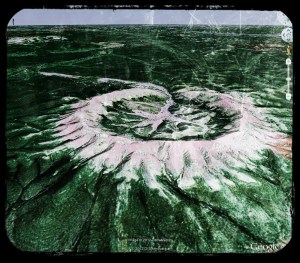
And, this is where it gets geeky, I decided to see how they look in the flight simulator FSX. Some are quite clear, often a near circular lake, or an obvious crater. One, in far eastern Siberia, is not actually an impact crater but an eroded intrusive pipe (Kondyor Massif). Now it’s one of Russia’s biggest platinum mines.
kondyor_pxlr