Ordinary commute with a fire

23°C, light Sth, full sun.

What’s that fire?

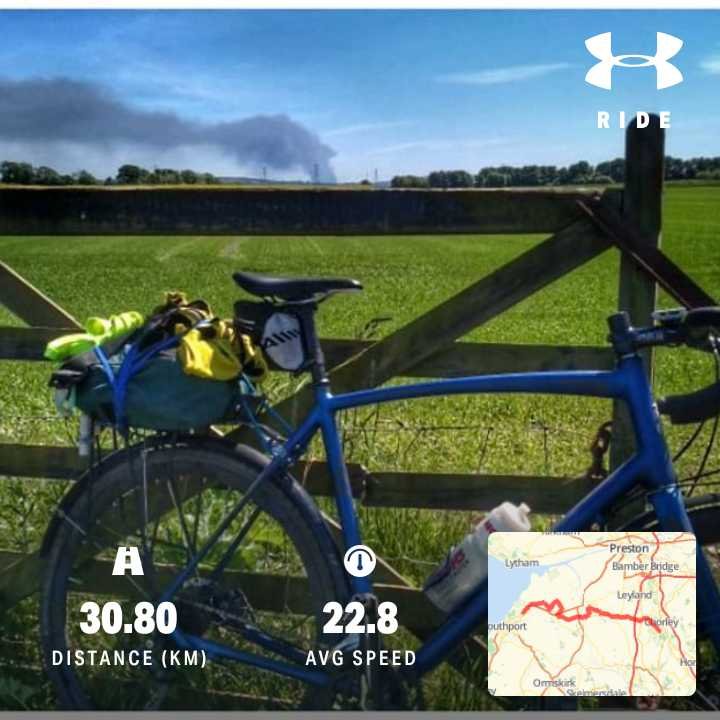
The oily black cloud of smoke seems to originate in South Lancashire. It seems too dark for a moorland fire. The plume trails all the way towards the lake District.

Later: news reports of an industrial fire in Newton-le-Willows, about 30 miles south of the place this photo was taken.

Talking without listening.

Britain seems to be an increasingly angry place. Were talking about it since the Brexit vote of 2016. The papers, online, radio and TV are filled with people expressing opinions. They are talking but not listening.

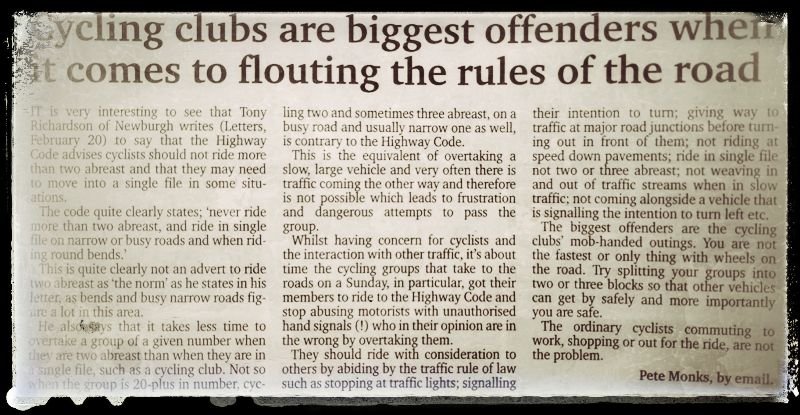
Here is a letter to the local paper that characterises the Angry Letter Writer. See below.

His opinions certainly don’t reflect my 30 year’s experience cycling with clubs. However, there were times when drivers made it clear that they were angry with us. I used to notice their reactions when I lived in Bristol, but not in Staffordshire.

My strongest disagreement is with the assertion that club cyclists are the biggest problem on our roads. He has not considered motorists speeding, running red lights, having no insurance, tailgating and so on. In his mind, the nuisance of overtaking club cyclists is greater than the loss of life associated with the driving offences listed above. It is so easy to refute each argument that I won’t bother. The overall theme is anger.

The same letter was published in the Southport version of this paper but the name was withheld. In that case it was signed off as

Angry motorist, (name and address supplied). Has the paper slipped up and accidentally released his name?

Continue reading

Angry in the letters page.

A letter to my local paper:
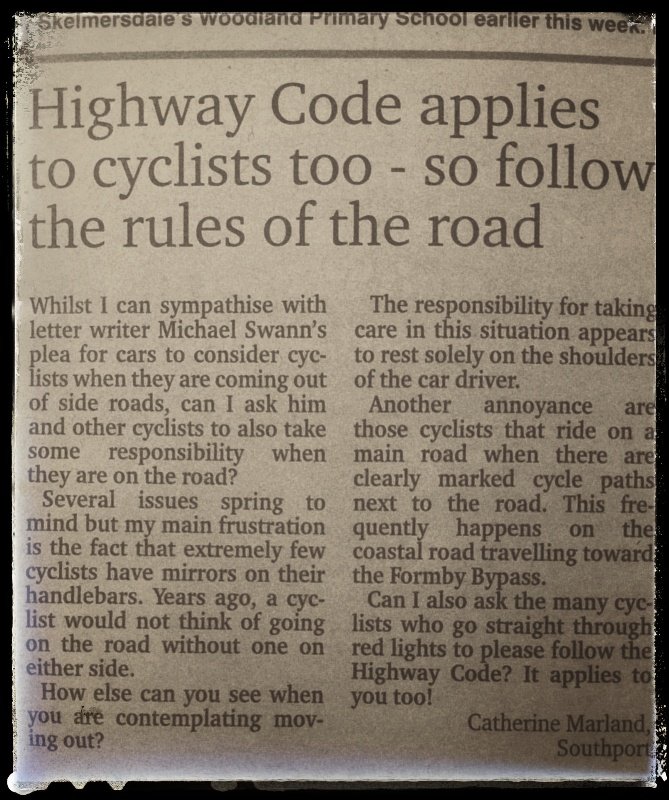
Whilst I can sympathise with letter writer Michael Swann’s plea for cars (#1a) to consider cyclists when they are coming out of side roads, can I ask him and other cyclists to also take some responsibility when they are on the road?

Several issues spring to mind but my main frustration is the fact that extremely few cyclists have mirrors on their handlebars. Years ago, a cyclist would not think of going on the road without one on either side.

How else can you see when you are contemplating moving out? #2

The responsibility for taking care in is situation appears to rest solely on the shoulders of the car driver.

Another annoyance are those cyclists that ride on a main road when there are clearly marked cycle paths next to the road. This frequently happens on the coastal road travelling toward the Formby Bypass. #3

Can I also ask the many cyclists who go straight through red lights to please follow the Highway Code? It applies to you too! #4

Catherine Marland, Southport

________________

#1a: cars don’t think.

#1/ I am old enough to remember kids proudly riding Raleigh Choppers which actually did come with 2 handlebar mirrors. They were trying to look like motorbikes. Nobody else used mirrors on a bike, there was never a time when mirrors were the norm for cyclists.

Personally, I’d never trust the narrow view from such a tiny porthole that a bike mirror provides. I don’t use a mirror because I value my safety.

#2: For those few who don’t know, mirrors are rarely fitted because there is a far more effective method – look over your shoulder! I can’t tell why Catherine didn’t think of that.

Most of us have a neck with 12 vertebrae which is a biological feature that allows us to turn our heads.

#3 that particular track is very narrow and lumpy there is no passing space for incoming bikes. Imagine driving on a single-track lane but without any passing spaces!

#4 just like car drivers always do?

I never jump red lights but there are many who assume we all do. Those assumptions are wrong.

You specify cyclist who go straight through red lights; presumably you accept those who turn left on a red light (as done legally in the USA).

100 years

Fine, 12°C, blustery sun.

100 years is a significant anniversary, one century ago, WWI came to a sudden end.

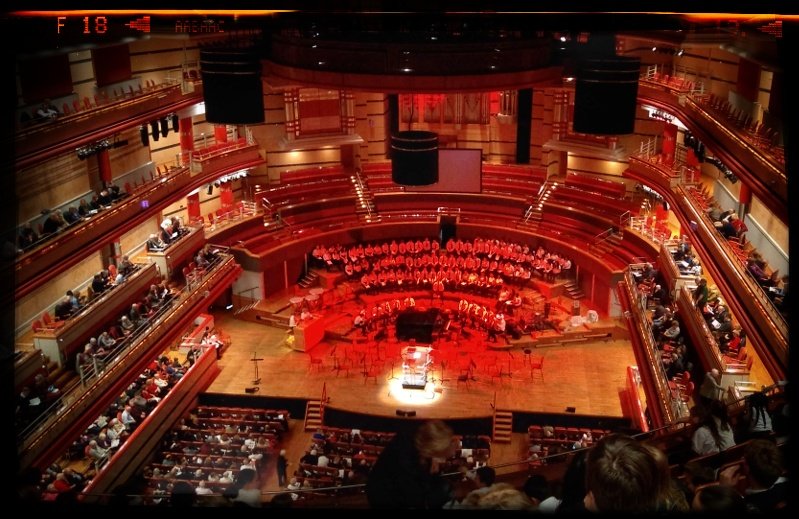
We marked the day with a trip to Birmingham’s Symphony Hall to see the lad perform in a choir.

Music: the performance was split in two across the interval. Before, each school’s choir performed and presented readings.

School orchestras can be slightly wobbly performers; for me, that’s a source of charm. Strings and brass seem to show this quality more than others. Usually, voices are spot on. Readings were delivered wonderfully, with clarity and measured pace.

Poppies: one moment stood out for me. The Last Post and 2 minutes silence are to be expected really. But then something spine tingling happened. The edge of your vision was caught by fluttering shapes. Red poppy petals slowly fell to the floor, sometimes, whole flower heads. It’s ironic that the most poignant moment in a concert was silence. That was a beautiful moment that afternoon.

The second half was taken up by a grand performance of Mozart’s Requiem. A strange choice, I thought; it was written over 150 before the Great War. I didn’t see what it offered of relevance to this day. The Requiem is a long drawn out dreary piece that left many in the audience browsing through their copy of the programme. With so many composers of the early 29thC who relate to the birth of modernity, why Mozart? The choice was probably a comprise selection to satisfy the 8+ schools who took part. Mozart undoubtedly has innovations to offer in the context of his time, but the modernist shift was far more fundamental. For some, Mozart represents the conformity and obeyance that led to the WWI disaster. One level, his Requiem represents poor taste.

It was lovely to see Birmingham.

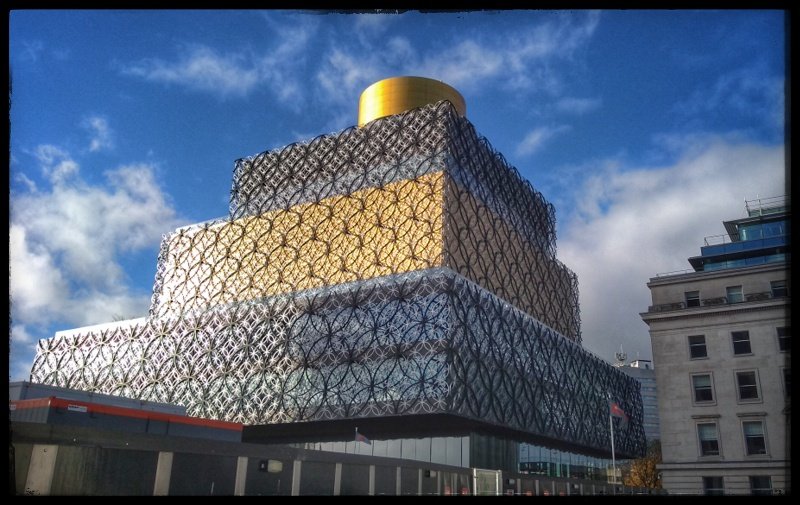
You can forget how attached you are to a town until a later return: much has changed, new buildings and more going up.

Prisoners’ votes.

BBC.– prisoners won’t get the vote after all. The story brought up all sorts of arguments about justice, European interference, sovereignty and stuff. My problem was that I couldn’t easily make the bridges between arguments presented. On one hand, the debate is not really that important- the number of prisoners is relatively small and many of them aren’t going to vote anyway. The other side revolves around arguments of principle.
image
Today, I have made some headway after reading the above linked feature. There are several strands to balance:
Prisoners with long terms, more than one parliamentary term won’t be free to benefit from their vote. The changes in society voted for, they wouldn’t see.
Prisoners will not have their right to vote taken away by the state, they have made choices that led them to jail.*
Prisoners may be incarcerated for behaviour that was in protest at government policy. They could still retain the vote, in my scheme, so can still affect law-making.

So my current position is- give them the vote unless they are sentenced for a long time, longer than a parliamentary term.

Anyway, shut up, I am tired and want to go.
Posted on my phone.

Rioting = fun?

Is rioting good fun? I’ve never tried it myself but I hear that they’re rioting in Northern Ireland, something to do with how often they fly flags. A decision made by democratically elected local government, it’s said. Their own leaders have told the rioters to stop, but continues today.
In NI, have a long record of extreme action triggered by trivial, silly issues- flags, parades, marches and so on.
So with such absurd causes, what is the real reason for that behaviour?

Crime minister.

6°C, no wind.
No I didn’t vote yesterday either. I stayed away from the polling booth along with 88.4% of the electorate. One polling station ( in Devon I believe) didn’t receive a single vote. In that time, questions floated in my mind; what is crime commissioner? What do they do? And are we really supposed to make our decision based on the leaflet dropped through the door? There was nothing in it but party political nonsense. Why does the job have to be a political one?

One leaflet promised “more visible policing”- not the old “bobbies on the beat” cliché again is it? We know from previous experience that it looks great but makes little difference to crime prevention (it’s brilliant for crime re-location though). All I want these days from politicians is evidence based policy, giving sway to vested interests and pressure groups gives unsatisfactory results.

A very mysterious event.

Is it all over?

6°C, clear and starry (including Venus)
Is this trial over yet? Woke up to hear that US voding is complete. There were only two cannidates, they got the same number of votes but somehow Wilhard lost by a wide margin. The map is coloured by each state. Red for the right-wing and blue for the even-more-right-wing, or is that left wing in their currency? The news features centre around a small number do canndidates, and a large number of voders.
Their president, in practice has limited power, so at least when they elect a half-wit nazi (Bush), or an insane war mongerer (Reagan) they can’t do as much harm as they’d like. I don’t argue with Americans’ right to vote, nor that the outcome has an effect on us non-Americans, but that it would have been better to limit election news stories to once a month until this week. It doesn’t seen to matter who they get, whoever wins will still exert economic power (protectionism), world power (mainly by bombing people), environmental (by polluting us all) and general bullying.
British TV has bored and annoyed us with this story since Easter, and will drag it out some more I fear.
Morning news will remain un-watchable for some time.

Cash in hand

26°C, Sun, little wind.

It’s morally wrong: BBC. Spot the stupid assumptions-

  1. Cash paid to a builder is not declared for tax purposes.
  2. house-holders have a responsibility for the way tradesmen handle their tax affairs.

It’s okay though, politicians can make such declarations because they are experts on immoral behavior. This isn’t going to go down well, phrases like “people who live in glasshouses shouldn’t throw stones” spring to mind. I suppose it’s true that I am drawn into grumbling about the social demons policiticians and bankers. Grumbling is a bad thing and has the danger of becoming a habit. Let’s leave it there.