Bronze practice (B).

Warm, windy with heavy rain. 12°C, and 16 in sunny spells.

In stark contrast to the previous expedition, we had terrible weather, probably the works DofE weather we’ve ever had. The kids took it on well; in fact better that the A group did on their warm, sunny days. This trip’s whingeing and moaning was conspicuous by its absence. Perhaps the participants’ ability to cope with heat is worse than rain. Since it’s summer, the rain was never cold so those who neglected to bring water-proof trousers got away with it. Practice is a time to find out what to bring and what to leave behind. Only 1 girl was carrying more than 15kg in her bag. It wasn’t obvious what the excess load was but other groups have taken too much or unsuitable food (tins, bottles or liquid food. I suggested that keep one liquid food meal and leave the others in the minibus to take back afterwards.steppingStones
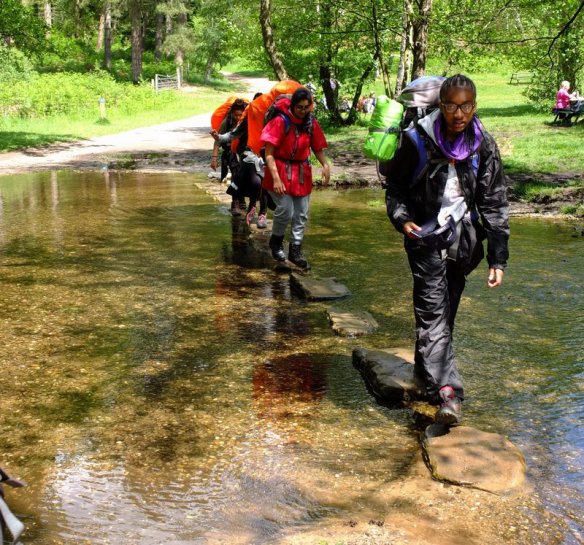
The weather wasn’t just wet, a storm was passing north-east in the Atlantic and that drove strong winds our way. Gusts peaked at 40mph+ threatening our tents. Once we got to camp, I told them to pitch tents with the pointy end facing the wind (west) and be extra-careful with pegs. The ground here is difficult to drive pegs into, there are thousands of round pebbles under the grass and pegs often hit them. If you can manoeuvre the peg round  these obstacles, the grip is quite good. once all the groups had finished supper and climbed into their tents to keep dry, I toured round with a rubber hammer.
As I drove pegs in, Dr. D brought me a cup of tea so that I held a cup in one hand and hammered with the other. all this time, heavy rain roared down diagonally across the site. However, it wasn’t cold and I wore full waterproofs.
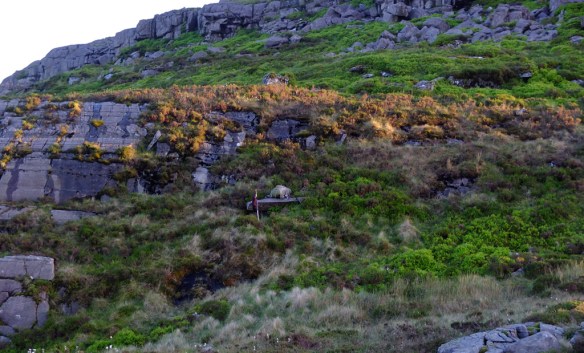
Rhynogydd walk-out

Dense hill fog to start 11°C. Later nice sunshine with a chilly wind.

Woke at 7am, all nice and warm in the bag. I didn’t want t get up, especially now that thick hill fog had set in.
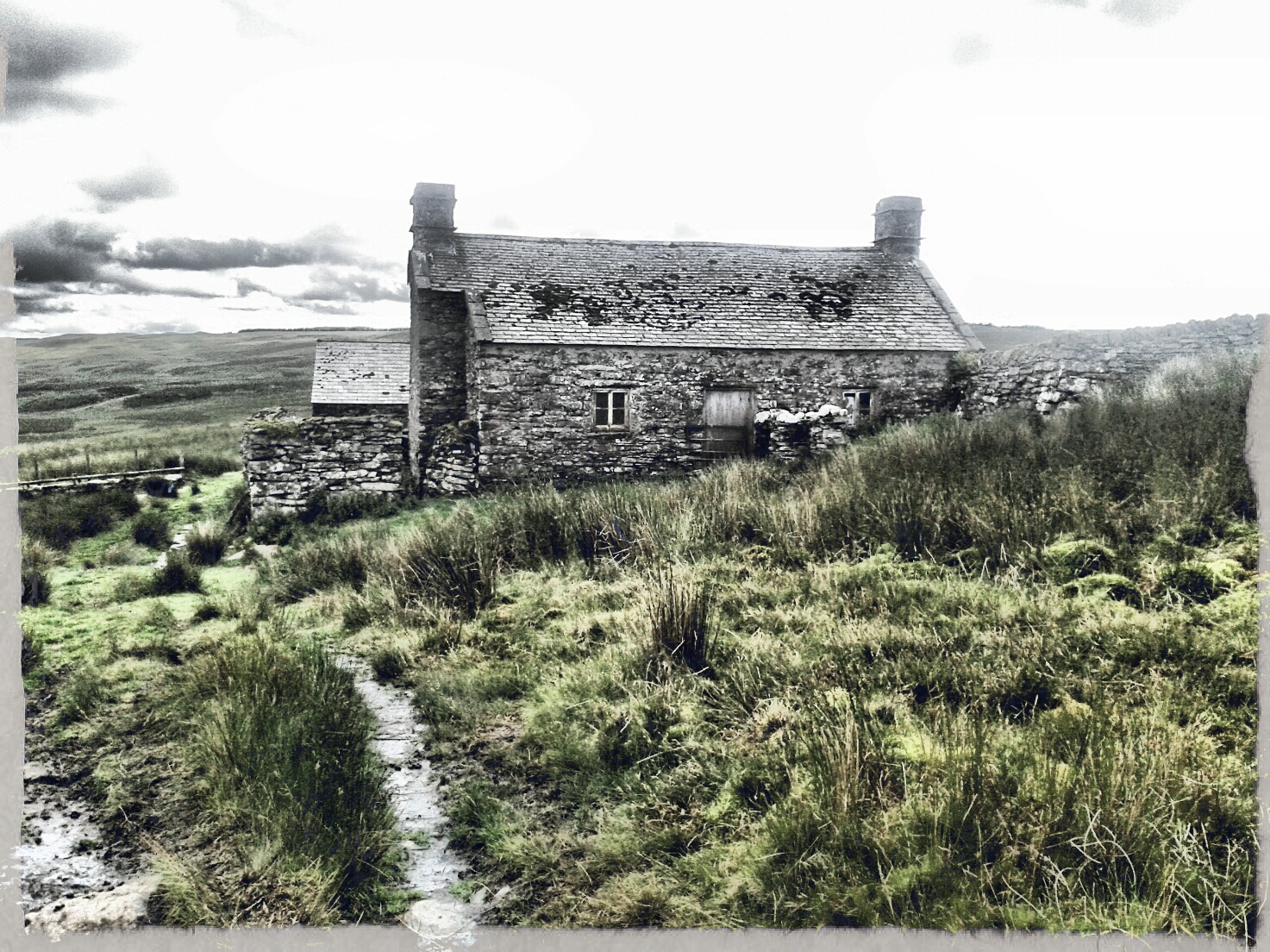
After a failed search for water, the descent near “The Clip” was easy to find. It is named Bwlch Gwynlio which takes you to the path down west to Cwm Bychan. Co-incidentally, I found water here too so turned it onto a coffee stop.

rhinoggBivvySite

My bed for the night.

Once refreshed, turn right and drop down towards Cwm Bychan, some of the route is overgrown with bracken. Annoyingly, I lost the path and strayed down from the ‘correct’ route.

Back to the familiar Cwm Bychan site. Disappointingly, nobody has taken over the campsite and it remains only a car-park for hikers.  The attraction for many casual hikers is the Roman Steps. Small family was starting out as I arrived and asked for directions. they had no map, but really, apart from the first part, they won’t need one if they stick to the slabs.
The excuse for this diversion was to find out whether the campsite has re-opened (it hasn’t). Then up the Roman Steps route which is familiar to me. The new bit is to drop down into the forest directly east. Navigation here was tricky because recent logging work has obliterated paths and their signs. I took a mixture of paths and foresters’ tracks to get to the extensive grasslands north. Every step was a ‘splosh’, hours and hours of welsh steppe. The walkout back to Trawsfynedd is very long; very long. These landscapes are heavenly.

While recovering back at camp something amazing happened. The family I met at Cwm Bychan pulled up in their car. They had my solar-battery pack. It had fallen off my backpack on the Roman steps. They felt that since I was so helpful that it was worth the slight detour to find me. I must have said where I was camping and there are only 2 sites near Trawsfynedd to try out. They had made their hike to the top of the Steps and appreciated the little arch bridge along the way. It’s a charming section which soon splits into two routes, the main path is clear enough all the way.  People are good.

Rhinogydd Bivvy night.

17°C, fair breeze in fair weather.

It took all morning for the rain to clear so I waited patiently. It doesn’t matter because my plan was not to descend the mountain today. I will stay up there. After some experimentation with packing my 45 litre day bag, I decided to go ahead with the smaller bag.
My expedition pack in in for repair so can’t carry the little tent, even that won’t fit. However, the bivvy will. The sleeping bag and stuff fits inside a 45 litre pack with a tight squeeze. By lunchtime, that rain eased off.

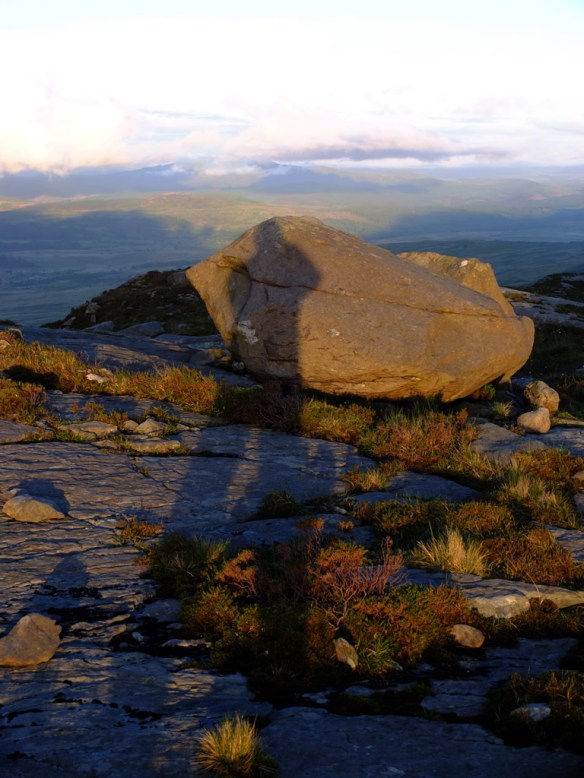
The start was across a waterlogged farmland and onto the hill. My route took a glancing path aside the range and then onto a bwlch (col). Suddenly, the sun shone and two possible routes presented themselves. Since I am by myself, I took the safer looking ascent to the west. Once on the ridge, the unique Rhinogg landscape laid out before me. The Rhinoggydd is part of what geologists call The Harlech Dome. It’s an ancient, Pre-cambrian sedimentary deposit which has pushed up to the surface. The rocks are hard and well consolidated for sedimentary rock types, a product of their very great age. Erosion has left us with rounded terraces, ice shattered rocks and layers of mixed grain beds. It was on one of these terraces that I opened out my bivvy bag. One small bolder overhand slightly, ideal shelter for my boots should it rain (it didn’t)

rhinoggSunset

Back to the sunset

As soon as the sun was down, the sky clouded over. The night was warm inside the bivvy and I carefully unzipped the bag to look out. Above was spread the twinkling universe and a planet that may have been Jupiter.

It took ages to get to sleep, and then ages to wake up in the morning. I was cosey in teh bed and dawn was thick hill-fog. Eventually, hunger for breakfast got me up at about 7 am.

Foel Boethe warmup.

17°C, set fair with a brisk SW breeze

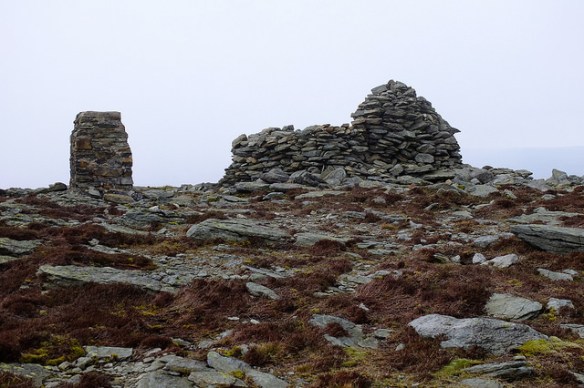
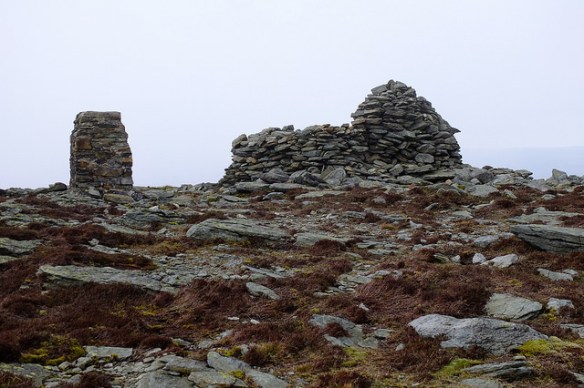
Medium pack walking in fine conditions. Footpaths are better signed this end of the range. The X-shelter on the map is literally a stone wall in the shape of an `X`. It`s in an odd place, I can`t see why there since there are summits nearby that may need shelter for mountain walkers. Perhaps it`s not for them. Perhaps it’s for the people who maintain the county boundary fences.34089312921_4a4f52d2bc_z

There was some faffing about on the descent, in one field, gorse overgrew a stile which was not visible until I had climbed over the fence. Relief that it was not my navigational error that hid the stile.

This was a very satisfying walk in easy conditions. The summits are not especially high but in a sea of rolling grasslands, the views were still very grand.

DofE Bronze Practice (a)

22°C, light wind and very bright sun.

First expedition of the season. Managing it was saner this year because we split the groups so we took only 35 at a time. Last year, we had 95 kids and although there were more staff, we’re still only 4 leaders (the others are supervisors). There were several nights when we got to bed well after midnight. One well after 02.30am. Alarms were set for 6- that was hard. I grabbed a kip in the afternoon knowing another late one was coming.
Perfect weather and manageable numbers didn’t prevent the kids grumbling, however. Oh dear, never mind. Half of the walking was in a forest and the other- gravelly scrub.
Forest navigation is tricky for anybody, but the groups were ingenious when finding ways to get lost. Most often, they would head off and find themselves back at a previous checkpoint having created an unintended circular route.
You can see it happening, the shoulders sink and hands are thrown down in a gesture of hopelessness.

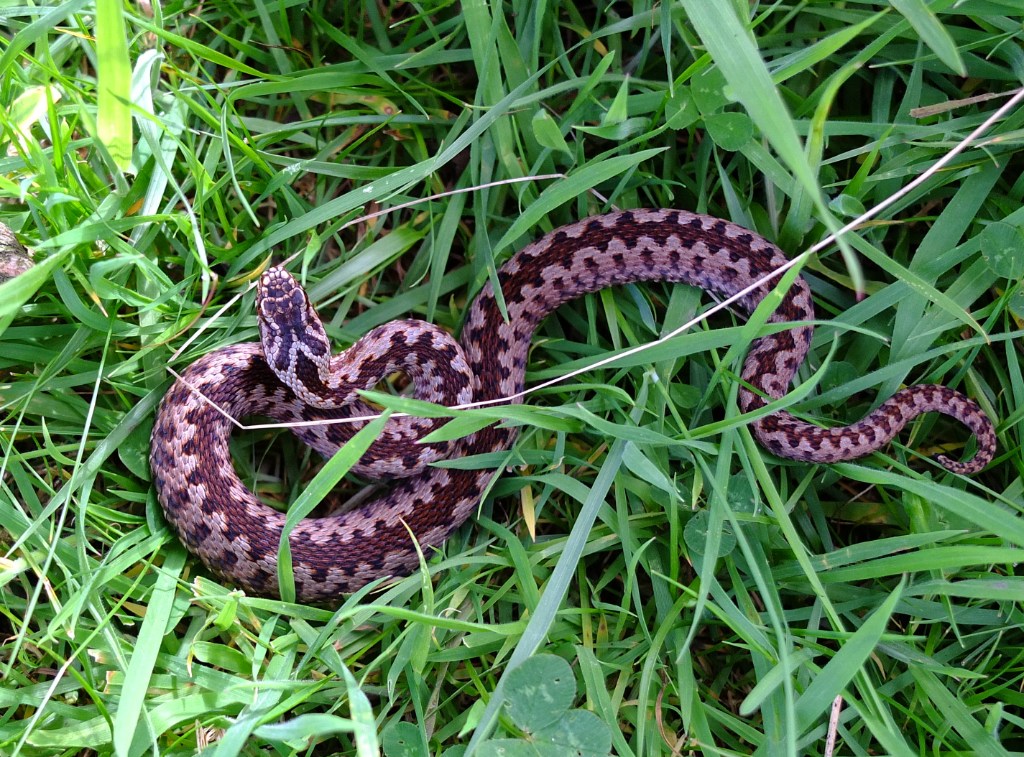
Cannock Chase is renowned for adders. Carl and I spotted one in the grass so I tried to photograph it. The first pictures missed so Carl blocked it’s path with a boot. It arched back like this and I got the shot. A split second later, it struck his boot with a bite. One angry snake. Good that it hit boot because they are capable to getting through trouser fabric. Carl has a few serious allergies, so it was good not to find another to add to his list. It would be typical that he didn’t have his epi pen.

Return from Cafngaw.

8°C, no wind, white cloud and dry.

I hiked with MapMyRide+! Distance: 10.35km, time: 04:16:00, pace: 24:44min/km, speed: 2.43km/h.

http://mapmyride.com/workout/2142592775

Cefngw bothy.


Up a bit late so finally woke after 7am. I blame that chocolate muesli bar from Aldi. Strong chocolate can do that. After walking for over 8 hours, I should have fallen into a solid sleep quickly. Normally, that’s what happens. I woke in the night after anxiety type dreams. I was worrying about the car in that isolated car park, away from the road. Images of broken windows and fire damage pestered my mind.

Woke late, the day was an hour old by then. At least I got the tent down quickly. Then plotted a route back that loops around the north of the mountain. There is a lake that might be good to visit but I missed it while picking the easiest route through the heather.
Once past the bwlch, the land opened out into an enormous ocean of grass, softly undulating to the northern horizon. I wonder whether Scotland has anything like this?
Curving round to the east, the land dipped towards the first signs of civilisation. A couple of farms appeared on the Llyn Arenig which flows into the reservoir by the car park.

Rather like the start, signage is poor but the public paths were clear enough on the map. I don’t like simply striding through somebody’s farm, especially with newborn lambs. I took a wide circuit around them. It’s no good to cause stress to their mums.

Arenig Fach up.

8°C,light wind and dry. Some cloud above 500m.
I hiked with MapMyRide+! Distance: 10.21km, time: 08:15:00, pace: 48:29min/km, speed: 1.24km/h.

http://mapmyride.com/workout/2142574688

Stuart at about 10.15. The first paths were a bit tricky to find. The map was clear enough but on the ground, no signs, so stiles, nothing. I have always wanted to walk the Migneint Moors, now here’s my chance. It wasn’t as boggy as I expected but kid heather was hard work. This spring has been quite dry, I’m grateful for that.
The trick here is to look well ahead to find strips of grass that run between heather fields for easier passage. It’s worth getting to a ring contours for the view ahead. Even here, grass is in big tussocks, so each stride is awkward. People with shorter legs might struggle. I wouldn’t bring a DofE group here.
34089312921_4a4f52d2bc_z

Arenig Fawr evening

10°C, dry with light high cloud.
I hiked with MapMyRide+! Distance: 13.75km, time: 04:35:00, pace: 20:00min/km, speed: 3.00km/h.

http://mapmyride.com/workout/2142590177

34089341941_2a57e13777_k

At 4pm, I decided to go. I was parked and in a good place to choose from a few options. The weather is very stable right now and it hasn’t rained for weeks. I threw some rude in the rucksack including my stove and supper. That turned out to be a very good idea. Just in case, I packed a spare torch too.
The route started simply, then a possible ascent onto the west of the ridge opened up.
These aren’t massive mountains, so making the first top was easy enough at 700m.
I got my breath back while taking photos and then took the ridge East. The summit is visible all the way. A cairn at the top has very good shelters. There was an ideal spot to get the stove out and make cous-cous. To improve it, I sliced up some cheese and had a very pleasant meal in a rather wonderful place. Familiar mountains were visible in each direction. The Rhinogau, Cnicht, Snowdon and the Gliderau.

Walk to recover.

19°C, bright sun building wind later.
I hiked with a medium pack:  Distance: 16.74km, time: 02:52:01, pace: 10:16min/km, speed: 5.84km/h.

http://mapmyride.com/workout/2114464646

The idea was to walk a few miles across farmland and practice DofE Bronze terrain navigation. Yesterday, I was all aching with a cold and it spread to my chest. Cycling was out of the question on this beautiful day.
Despite a few changed public rights of way, I made no navigation errors. Quite the opposite, the navigation was too easy really.
The ground is solid, soil is all hexagon cracks like in those pictures of deserts.
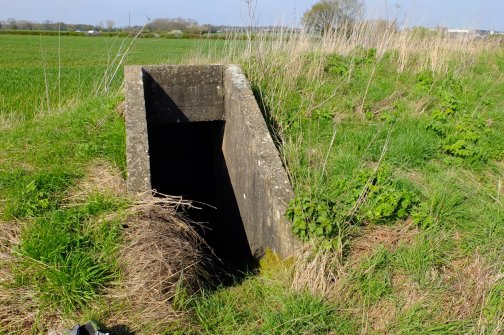
The route covered land formerly on a WWII airbase.fradBunker

This is some kind of bunker, it has a chimney but no windows or pill-box style slits of any kind. Inside was fairly fresh water full of duck-weed (or something similar).

The next bit involved crossing the old runways by a public right of way. However, something got in the way. There is a new housing estate being built. No signs of the path were visible nor were there notices on lampposts. I dropped in the housing office. The woman there didn’t know where the path was diverted to, but was adamant that I couldn’t pass through the building site. Obviously.
I knew that but she tried to divert me along a road. I didn’t want to do that, lie path must be somewhere. She then said ‘I’d have to say the path is closed’. No it can’t be, that would be illegal.
What home is it if you don’t know but prefer to say something that is wrong.
As it turned out, I found it behind a supermarket, against her advice.
The rest of the route map very nice. There were a few fallen massive trees to clamber by.

The day’s total milage amazed me. More than Ten miles. I had imagined about six. For 2,500 calories, I felt remarkably fresh despite feeling ill yesterday. What am excellent way to recover.

Testing the kettles.

9°C, sunny with showers.
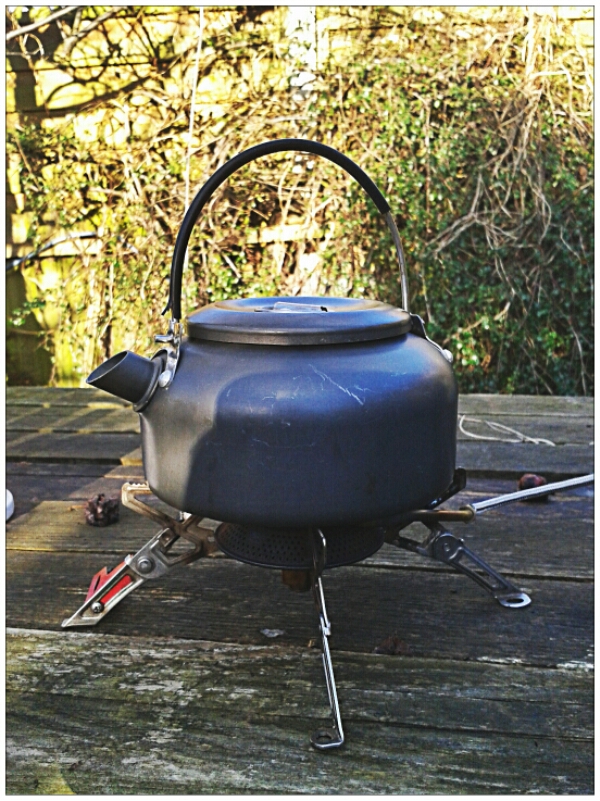
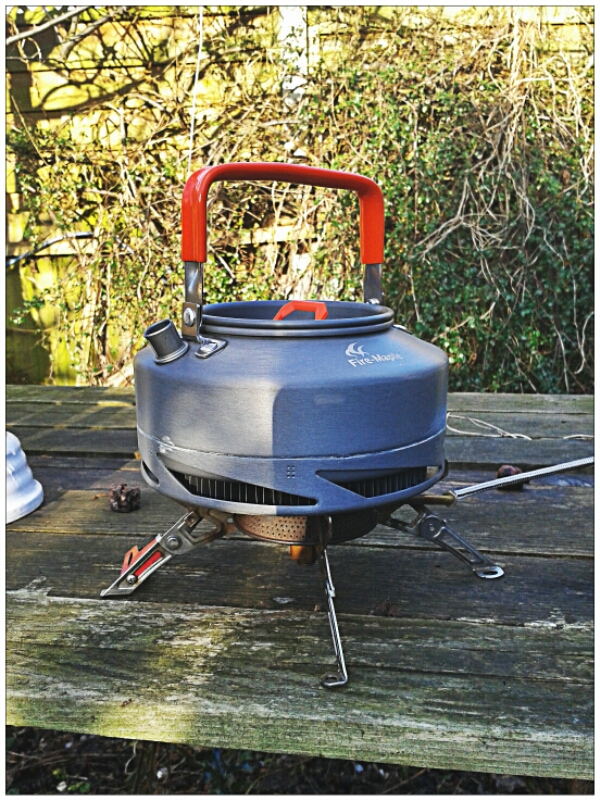
I’ve tested the new kettle today. The new one, with a heat-exchanger on the bottom promises faster boil times. Cold mornings can be a problem on a camp because the low temperature dramatically affects the time it takes to make breakfast. Maybe like me, you really want a coffee first thing to start the day.
To test these pots, I put 400ml of your at the same temperature. I timed each pot to the point when steam appeared when I hit Stop on the stopwatch. The stove is a Primus, the type with a hose and a loop of pipe that is pre-heated by the flames.
Here’s the results:

Plain kettle.
3’10”, 130g.

Heat-exchanger Kettle.
2’40”, 250g

Heat-exchanger Pot.
4’10”. 280g.

I’m a bit worried about the last result. The gas can chilled so much that it froze to the table. Gas pressure drops away dramatically when cold. This may have lengthened the boil time despite the heat sink.
Here is a close-up of the heat sink in case you’re wondering what it means. The idea is to increase the area in contact with the flames. This folded metal has a larger surface area and also channels the hot gas along the pot’s base.

In conclusion, I think the heat-exchange pots are worth having for the boil times. The only disadvantage is the extra weight.